
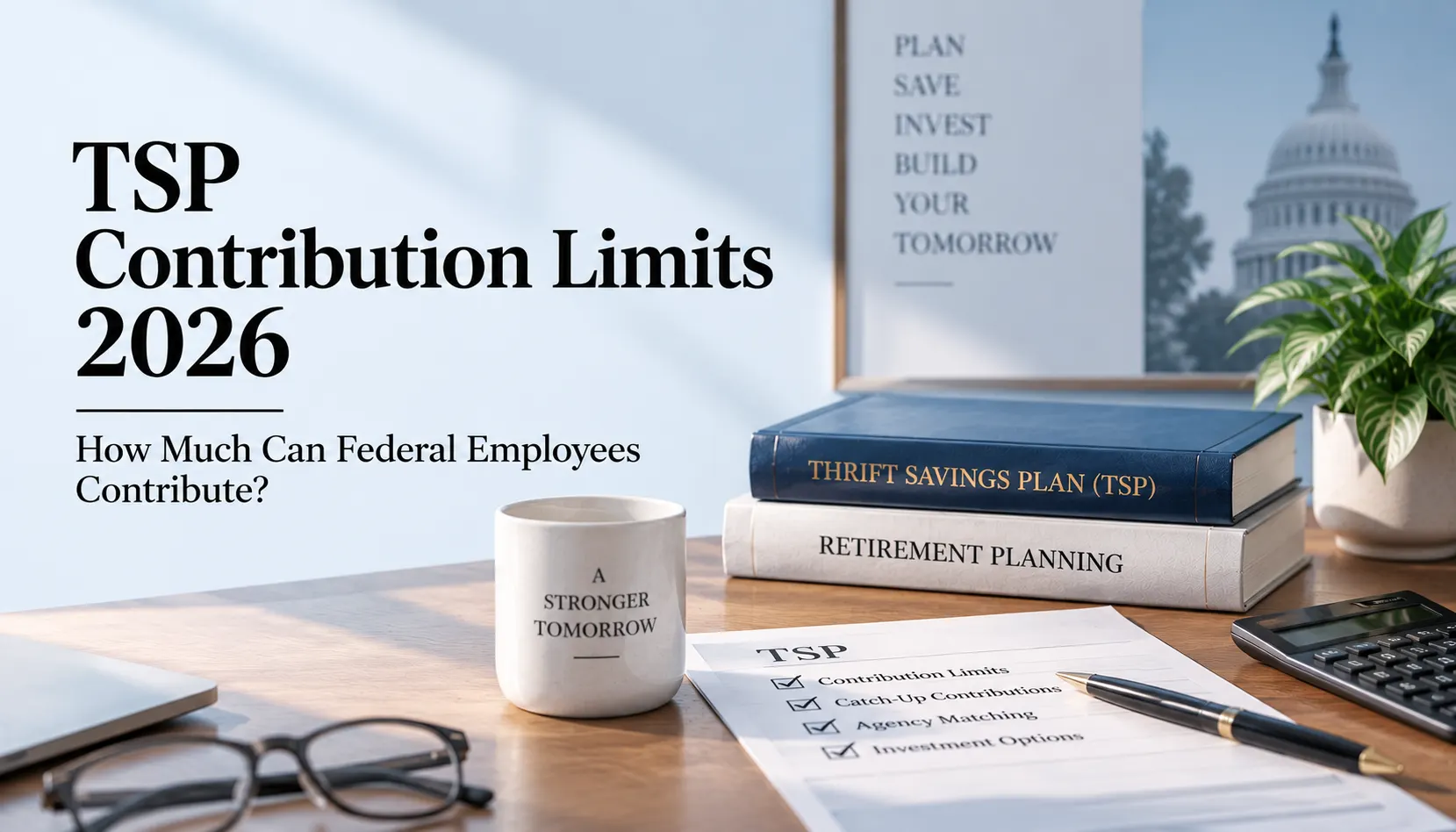
The Thrift Savings Plan (TSP) is an important retirement savings program for federal employees and members of the uniformed services. Understanding TSP contribution limits, catch-up contributions, agency matching, and available investment funds can help you make more informed retirement planning decisions.
For 2026, the annual TSP elective deferral limit is $24,500. Participants age 50 or older may generally contribute an additional $8,000 in catch-up contributions. A higher catch-up limit of $11,250 applies to participants who attain age 60, 61, 62, or 63 during 2026, subject to applicable rules.
Your appropriate contribution and investment strategy depends on your income, retirement timeline, financial goals, risk tolerance, and other retirement resources.
The 2026 TSP contribution limits are:
The $24,500 elective deferral limit applies to the federal government’s TSP under the applicable retirement plan rules.
The enhanced catch-up provision for participants who attain ages 60 through 63 comes from the SECURE 2.0 Act.
Beginning in 2026, certain catch-up contributions must be made as Roth contributions if the participant’s prior-year wages with the plan sponsor exceeded the applicable threshold. For 2026, the IRS specifies a $150,000 wage threshold.
There is no single contribution strategy that is right for everyone. However, several considerations can help you evaluate your approach.
Review how much you currently contribute and compare it with the applicable annual limit.
For 2026, the regular elective deferral limit is $24,500. If you are eligible for catch-up contributions, your available limit may be higher.
Rather than waiting until the end of the year, consider how your contribution rate fits into your regular paycheck and overall budget.
Your income, expenses, debt, emergency savings, and other retirement accounts can all affect how much you may reasonably choose to contribute.
For employees covered by the Federal Employees Retirement System (FERS), agency contributions can be an important part of TSP planning.
Generally, FERS employees receive:
Contributing at least 5% of basic pay generally allows an eligible FERS participant to receive the full agency matching contribution, subject to applicable rules.
Employees who contribute heavily early in the year should understand how their agency matching contributions are calculated.
Your payroll and agency rules determine how contributions and matching work. Review your specific circumstances to avoid making assumptions about how reaching the annual limit may affect matching contributions later in the year.
The TSP provides several core investment funds, along with Lifecycle (L) Funds.
The Common Stock Index Investment Fund (C Fund) tracks the performance of large U.S. companies through an index designed to represent the U.S. large-cap stock market.
It can provide long-term growth potential but also carries market risk.
The Small Capitalization Stock Index Investment Fund (S Fund) provides exposure to smaller U.S. companies outside the C Fund’s large-company universe.
Small-company stocks can experience significant price fluctuations, making the S Fund an investment with meaningful market risk.
The Government Securities Investment Fund (G Fund) invests in special-issue U.S. Treasury securities available to TSP participants.
The G Fund is designed to provide preservation of principal and interest income while avoiding the market-price volatility associated with conventional bond funds.
The Fixed Income Index Investment Fund (F Fund) tracks a broad U.S. bond index.
Bond investments can help diversify a portfolio, but the F Fund can lose value when market conditions cause bond prices to decline.
The International Stock Index Investment Fund (I Fund) provides exposure to international developed-market stocks under the fund’s applicable investment benchmark.
International investments can provide diversification but also involve risks associated with foreign markets, currencies, and economic conditions.
Lifecycle (L) Funds are diversified portfolios designed around different retirement time horizons.
Their asset allocations automatically change over time according to the fund’s target date and investment strategy.
There is no universally “best” TSP fund.
The appropriate investment mix depends on factors such as:
A fund that may be appropriate for one participant may not be appropriate for another.
Investment performance also changes over time, so choosing a fund based solely on which one performed best recently can expose investors to unnecessary risk.
Someone with decades until retirement may have a different risk capacity than someone who expects to begin withdrawals soon.
Stock funds can experience substantial market declines. Investors should consider whether they can remain comfortable with market volatility during periods of falling prices.
Holding investments across different asset classes and markets may help diversify certain risks.
The TSP’s available funds provide different types of exposure, and the appropriate combination depends on your circumstances.
Federal employees should consider the TSP alongside other potential retirement income, including FERS or CSRS benefits and Social Security.
Your investment approach may also need to account for how and when you expect to use your TSP savings.
L Funds may be worth considering for participants who prefer a diversified portfolio that changes over time rather than selecting and periodically adjusting individual TSP funds themselves.
However, an L Fund is not automatically appropriate for every participant.
Before selecting an L Fund, consider its target date, underlying investments, risk level, and how the fund fits with your other retirement resources.
TSP participants may generally have access to both Traditional and Roth contribution options.
Traditional contributions are generally made before federal income taxes are applied to the contribution. Withdrawals are generally taxable as income when distributed, subject to applicable rules.
Roth contributions are made with after-tax money. Qualified Roth distributions can generally be tax-free if applicable requirements are met.
Choosing between Traditional and Roth contributions can depend on your current tax situation, expected future tax circumstances, income, retirement timeline, and overall financial plan.
There is no universal answer that is right for every federal employee.
Employees early in their careers may have a longer investment horizon.
They may want to focus on:
Mid-career employees may want to review whether their savings rate remains aligned with their retirement goals.
Consider reviewing:
Employees closer to retirement may need to focus more closely on:
The appropriate strategy depends on the individual’s circumstances.
Not necessarily.
Contributing the maximum possible amount may be appropriate for some employees, but retirement planning involves more than simply reaching the annual contribution limit.
Before increasing TSP contributions, consider whether you have:
For some employees, increasing TSP contributions may be a priority. For others, balancing retirement savings with current financial obligations may be more appropriate.
Some employees may choose to use both Traditional and Roth TSP contributions as part of their overall tax strategy.
Using both can provide different tax characteristics in retirement, but the appropriate mix depends on your income, tax circumstances, retirement expectations, and other accounts.
A qualified financial or tax professional can help you evaluate the potential implications.
The regular TSP elective deferral limit for 2026 is $24,500. Participants who qualify for catch-up contributions may be able to contribute more.
Participants who are age 50 or older may generally contribute an additional $8,000 in catch-up contributions in 2026, bringing the potential total to $32,500 when combined with the $24,500 regular limit.
Participants who attain age 60, 61, 62, or 63 during 2026 may generally be eligible for an enhanced catch-up contribution limit of $11,250. Combined with the $24,500 regular limit, that can result in total elective contributions of up to $35,750, subject to applicable rules.
The primary TSP investment options include the C, S, G, F, and I Funds, along with Lifecycle (L) Funds.
There is no single TSP fund that is best for every federal employee. The appropriate choice depends on your investment objectives, retirement timeline, risk tolerance, diversification needs, and other financial resources.
The C Fund can provide exposure to large U.S. companies and long-term stock-market growth potential, but it also carries market risk. Whether it is appropriate depends on your overall investment strategy and circumstances.
The G Fund may appeal to participants who prioritize principal preservation and stable interest income. However, the appropriate role of the G Fund depends on your retirement timeline, risk tolerance, income needs, and broader portfolio.
An L Fund may be useful for participants who prefer a diversified portfolio that automatically adjusts its allocation over time. Review the fund’s target date and risk characteristics before choosing one.
For eligible FERS employees, contributing at least 5% of basic pay generally allows the employee to receive the full agency matching contribution. However, individual circumstances should be considered when determining an appropriate contribution rate.
Yes. Retirement plan contribution limits can be adjusted periodically based on federal law and cost-of-living adjustments. Always check current IRS and TSP guidance for the applicable year’s limits.
Understanding TSP contribution limits is only one part of federal retirement planning.
Your TSP strategy may need to be considered alongside FERS or CSRS benefits, Social Security, taxes, insurance, investment risk, retirement timing, and your broader financial goals.
Federal Employee Advisor Network helps federal employees and retirees connect with independent financial professionals who may be familiar with federal retirement planning.